
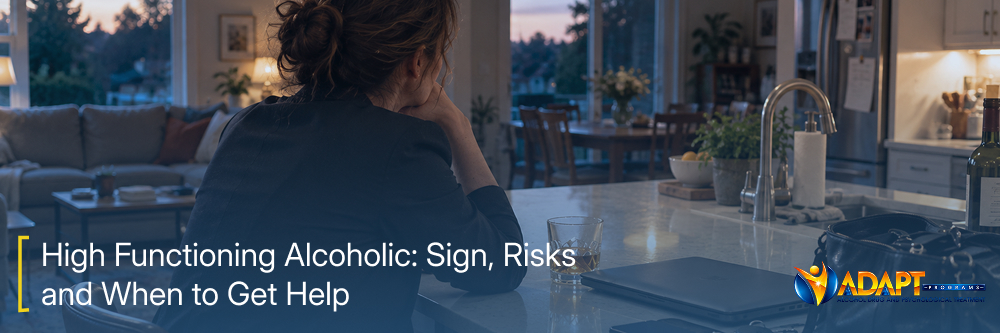
The phrase “high-functioning alcoholic” describes something the clinical term “alcohol use disorder” does not quite capture: a person who drinks at levels that clearly indicate dependence but manages, for a time, to keep the damage mostly invisible. They hold demanding jobs. They show up for their kids. They pay their bills. From the outside, nothing appears wrong – which is exactly what makes this pattern so difficult to identify and so dangerous to leave untreated. The NIAAA has estimated that roughly 20 percent of people with alcohol use disorder fall into this functional category. It is not a formal diagnosis. It is a description of how addiction can run alongside apparent competence until it can no longer.
What High-Functioning Alcoholism Really Means
The term is colloquial, not clinical. The DSM-5 does not distinguish between a “functioning” and a “non-functioning” alcohol use disorder. What the research shows is that people who maintain outward performance while dependent on alcohol have generally developed sophisticated systems for compartmentalizing their drinking – drinking only at “acceptable” times, keeping alcohol in contexts that look social, calculating how much they can consume before a morning meeting. These strategies can delay visible consequences for years. They do not, however, slow the progression of physical and psychological damage.
The clearest distinction between this group and people whose alcoholism is more visibly disruptive is that the damage stays private longer. Liver strain, cardiovascular changes, sleep disruption, anxiety, and cognitive changes are happening beneath the surface while the outward performance holds. The person most resistant to acknowledging the problem is often the one with the most evidence that they are “fine” – because the professional success, the intact marriage, and the mortgage payments all feel like proof that the drinking is not that serious. This is why high-functioning alcohol use disorder is often the last to get treatment and the hardest to intervene on.
Signs of a High-Functioning Alcoholic
These signs are easy to dismiss because each one can seem explainable on its own. The concern is when they start forming a pattern, especially when alcohol is being used to feel normal, manage stress, or avoid withdrawal symptoms.
- Drinking alone or early in the day: Alcohol starts becoming part of the routine rather than something limited to social situations.
- Drinking more than planned: A person may intend to have one or two drinks but regularly ends up drinking more.
- Needing alcohol to relax or feel confident: Situations that once felt manageable without alcohol start to feel harder without it.
- Blackouts while still appearing functional: Someone may continue working, socializing, or carrying on normally while later having little or no memory of what happened.
- Joking about having a drinking problem: Repeated jokes can sometimes be a way of brushing off a concern that already feels uncomfortable.
- Getting defensive when drinking is mentioned: Anger, irritation, or shutting down the conversation can be a sign that the subject is hitting close to home.
- Withdrawal symptoms between drinks: Tremors, sweating, anxiety, or a racing heart when alcohol wears off can point to physical dependence.
- Using alcohol to stop those symptoms: Drinking to calm shaking, anxiety, or discomfort is a much stronger warning sign than simply drinking too much at a social event.
Someone can still hold a job, manage a household, and meet responsibilities while alcohol dependence is developing. Outward stability does not cancel out what the body is showing.
How Drinking Slowly Becomes Dependence
Most people who develop this pattern did not set out to become dependent on alcohol. The progression follows a recognizable track. Drinking starts as a coping mechanism – a way to manage stress, social anxiety, or the emotional demands of a high-pressure career. The relief it provides is real, which reinforces the behavior. Over time, the same amount of alcohol produces less relief, so the quantity increases. Tolerance develops. The person needs more to feel what they used to feel with less. By this stage, the drinking is no longer a choice made consciously at the end of each day – it has become the default state, and not drinking is what feels wrong.
The third stage is when the rationalization becomes more active. Excuses get more elaborate. Drinking is explained as networking, decompression, or a reward that high performers deserve. The person may limit their drinking to certain settings – only after 6 pm, only on weekends, only in social contexts – as a way of maintaining the internal argument that it is controlled. These self-imposed rules break more often than they are kept. The rules themselves are evidence of awareness that the drinking is a problem, even as the behavior continues. At this point, the gap between what the person tells themselves and what is actually happening has become wide enough that even the people closest to them may not fully see it.
The Health Effects That Can Stay Hidden
Heavy drinking can affect far more than what other people can see. Someone may still be working, paying bills, and keeping up appearances while alcohol is already affecting sleep, physical health, mood, and the people closest to them.
- Liver damage: Long-term heavy alcohol use can strain and damage the liver even when there are no obvious outward signs.
- Heart and blood pressure problems: Alcohol can raise blood pressure and increase the risk of cardiovascular disease over time.
- Higher cancer risk: Chronic alcohol use is linked with an increased risk of several types of cancer.
- Poor sleep: Alcohol can make it easier to fall asleep, but it disrupts normal sleep patterns and reduces REM sleep. That can leave someone tired even after spending hours in bed.
- Worsening anxiety and depression: Alcohol may feel calming at first, but regular heavy use can make anxiety and depression worse over time.
- Family members begin adjusting around the drinking: Spouses, children, and close friends may change plans, avoid certain conversations, or make excuses for the person.
- Enabling can develop quietly: Protecting someone from the consequences of their drinking often comes from concern or love, but it can also delay the point when the problem is addressed.
- The strain spreads beyond the person drinking: Even when work and daily responsibilities are still being handled, the people around them may already be carrying part of the impact.
Why the Problem Can Be So Hard to Recognize
Denial in a high-functioning alcohol use disorder is not simply dishonesty or stubbornness. It is cognitively reinforced by genuine evidence. The person looks at their career, their relationships, and their bank account and sees confirmation that the drinking is not affecting them. The popular image of alcoholism – someone who has lost everything and whose life has visibly collapsed – does not match what they see in the mirror. So the label does not fit, and the help feels unnecessary. The internal argument is circular and surprisingly airtight: if they were really an alcoholic, things would be worse. Things are not worse. Therefore, they are not really an alcoholic.
This is where external perspective matters. Drinking patterns that feel normal to the person experiencing them can look clearly problematic to a clinician assessing them against standard diagnostic criteria. The DSM-5 does not ask whether your life is falling apart. It asks whether your drinking is harder to control than you intend, whether you have tried to cut back and found it difficult, whether you continue despite knowing it is causing problems, and whether you experience withdrawal symptoms when you stop. Those questions produce a different answer than the one the person gets from looking at their job title and their intact family.
How to Talk to Someone About Their Drinking
The worst approach, backed up by both clinical experience and research, is a confrontational one delivered when the person has been drinking. Anger, ultimatums, and lists of grievances rarely produce the response a family member is hoping for. What tends to work better is a private conversation, at a calm moment, framed around specific observable behaviors rather than accusations or character judgments. “I’ve noticed you seem to need a drink before any social event now” lands differently than “you drink too much.” One describes a pattern; the other makes a diagnosis that the person can reject.
Having a concrete next step ready matters. Asking someone to acknowledge they have a problem without offering them anywhere to go with that acknowledgment leaves the conversation without traction. A confidential substance abuse assessment is a low-commitment starting point – it is not treatment, it is information. Telling someone they do not have to decide anything after a one-hour conversation with a licensed counselor removes a significant barrier. Most people who are ambivalent about their drinking can agree to get information. From there, the counselor’s job is to help them see what the numbers actually show.
What Treatment Can Look Like for Working Adults
One of the specific advantages of getting help before a crisis is that treatment options remain broader. Intensive outpatient programs are designed for people who are employed, who have families and responsibilities, and who cannot disappear from their lives for 30 days. These programs meet several times a week – morning and evening session times exist at many outpatient programs specifically for working adults – and cover the same clinical ground as residential care: individual counseling, group therapy, relapse prevention, and the behavioral work that addresses what the drinking was doing for the person. The outpatient model is not a lesser version of treatment. It is the clinically appropriate level of care for the majority of people with alcohol use disorder who do not have acute medical complications.
Medical detox is sometimes required first, depending on the level of physical dependency. Alcohol withdrawal is one of the few withdrawal processes that can become medically dangerous without supervision – severe cases can include seizures – so a clinical assessment should determine whether medically supervised detox is needed before outpatient counseling begins. After the primary program ends, aftercare support – ongoing weekly groups and check-ins – is where long-term stability gets built. People who stay connected to a support structure after completing treatment have significantly better long-term outcomes than those who treat program completion as the finish line. More detail on what the treatment process involves is available on the alcohol abuse treatment page, and the family’s role in recovery is covered separately for people supporting someone else through this.
Frequently Asked Questions
Is “high-functioning alcoholic” an official diagnosis?
No. The clinical term in the DSM-5 is alcohol use disorder, which is graded mild, moderate, or severe based on the number of criteria met. High-functioning alcoholic is a colloquial description, not a formal category.
How common is this pattern?
The NIAAA estimates that roughly 19 to 20 percent of people who meet the criteria for alcohol use disorder are functional in the sense described here – employed, maintaining relationships, with no obvious external collapse. Functional alcoholics are also statistically more likely to have a family history of alcoholism and, according to the same research, nearly half also smoke.
What is the difference between a heavy drinker and someone dependent?
A heavy drinker consumes more than recommended amounts but retains the ability to choose not to drink without significant physical or psychological distress. Dependency means the body and brain have adapted to alcohol’s presence and react with withdrawal symptoms – anxiety, tremors, elevated heart rate, insomnia – when it is removed. The line between heavy drinking and dependency is a clinical one, not a subjective judgment, and a licensed counselor can assess it in a conversation.
Can someone recover from alcohol dependence while staying employed?
Yes. Outpatient treatment is specifically designed for this situation. Most employers cannot legally discipline or terminate an employee who proactively seeks treatment under FMLA and ADA protections. The treatment itself – structured sessions scheduled around work hours – does not require disclosure to an employer.
What if the person refuses to admit they have a problem?
Denial is part of the condition and does not mean the person is beyond help. Families who want to address this are better served by getting informed themselves first – understanding what they are dealing with, where the options are, and what an assessment involves – before attempting another conversation. An outpatient assessment is available by phone for family members who want to understand the process before approaching a loved one.