
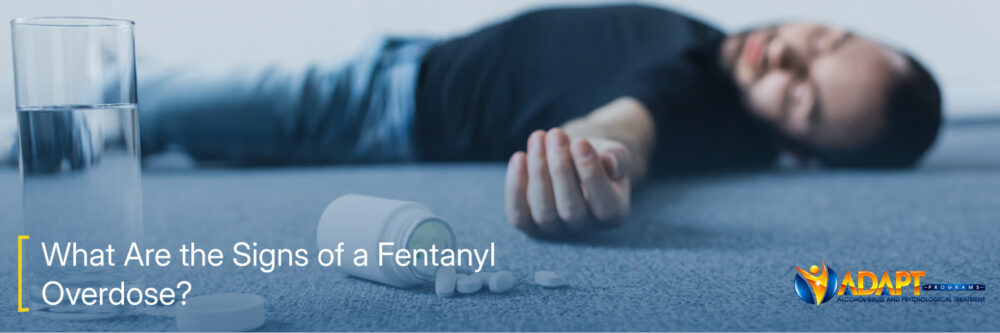
Three things together mean an opioid overdose until a paramedic says otherwise: the person will not wake, their breathing has slowed or stopped, and their pupils are pinpoints. If someone is in front of you right now, stop reading. Call 911, give naloxone if it is in the house, and start rescue breathing. Naloxone does nothing to a person who has not taken an opioid, so being wrong costs you nothing and being slow costs everything. The rest of this covers how to tell an overdose from someone who is simply very high, why fentanyl breaks the assumptions most overdose training was built on, and what the days afterward look like.
The Fentanyl Overdose Signs That Matter Most
The core three are called the opioid triad: unresponsiveness, respiratory depression, pinpoint pupils. Breathing is the one that decides it. It may drop below eight or ten breaths a minute, go shallow and ragged, or stop. A gurgling or choking noise, which people often describe as snoring that sounds wrong, means the airway is partly blocked and almost no air is moving. That sound is the emergency. It is not deep sleep and it is not someone sleeping it off.
Everything else follows from oxygen loss. Lips, fingertips and nail beds turn blue, grey or ashen, which reads fastest at the lips and under the nails on darker skin. The body goes completely limp. Skin turns cold and clammy. The pulse slows and weakens. The person does not react to their name, to a hard shake of the shoulders, or to knuckles ground firmly into the breastbone, which is the test paramedics use and the one that settles the question.
| WHAT YOU SEE | VERY HIGH | OVERDOSE |
|---|---|---|
|
Response to voice |
Slow, but answers | Nothing |
|
Response to sternal rub |
Reacts or wakes |
Nothing |
|
Breathing |
Slow, regular | Shallow, stopped or gurgling |
| Speech | Slurred, present |
Absent |
| Lips and nail beds | Normal colour |
Blue, grey, ashen |
| Muscle tone | Relaxed |
Fully limp |
The First Two Minutes
CDC data puts a bystander at the scene of roughly 43 percent of fatal overdoses. That number is the entire argument for knowing this sequence. Order matters less than speed.
- Call 911. Say the person is unresponsive and not breathing right. You do not have to say what they took.
- Give naloxone. One spray, one nostril. Nasal naloxone requires no training and there is no way to administer it that causes harm.
- Rescue breathe if they are not breathing. Head tilted back, chin lifted, one breath every five seconds. In an opioid overdose, this matters more than chest compressions, because the heart is usually still going and the problem is oxygen.
- Second dose after two to three minutes with no response. Fentanyl regularly needs more than one.
- Recovery position on their side once breathing returns, so they do not aspirate if they vomit.
- Stay. Naloxone wears off before fentanyl does.
Texas has a Good Samaritan provision that offers some protection from possession charges for a person who calls during an overdose, though it is narrower than the equivalent laws in most states and does not cover repeat callers or people with certain prior convictions. It is worth knowing and it should not factor into the decision. The call is what determines the outcome.
Why One Dose Of Naloxone Is Often Not Enough
Naloxone strips opioids off the brain receptors that regulate breathing. It works extremely well and it has one structural weakness: its half-life is shorter than fentanyl’s. Someone can come round, seem completely fine, insist they are fine, and then stop breathing again twenty or thirty minutes later as the naloxone clears and the fentanyl still in their bloodstream takes the receptors back. This is why walking away after they wake up is dangerous and why the ambulance still matters once the crisis appears to have passed.
The supply has changed in ways that complicate the response. CDC issued a health advisory after medetomidine, a veterinary sedative, turned up in nearly 35 percent of opioid-positive samples across 10 of 20 sentinel testing sites between July and December 2025. Xylazine has been in circulation longer. Naloxone reverses neither, so a person may stay heavily sedated after their breathing has been restored, and a bystander watching them stay unconscious may reasonably conclude the naloxone failed. CDC’s instruction is unchanged: give it anyway. Fentanyl is nearly always in the mix too, and breathing is the thing you are trying to fix.
Why People Overdose On Fentanyl Without Taking Fentanyl
Illegally made fentanyl is now mixed into cocaine, methamphetamine, heroin, and counterfeit pills pressed to look like Xanax, Percocet, or Adderall. It cannot be seen, tasted, or smelled. It does not distribute evenly through a batch, which is why two pills out of the same bag can contain completely different amounts and why one person is fine and the person next to them is not. CDC found that 75 percent of overdose deaths among 10- to 19-year-olds between 2020 and 2024 involved fentanyl, and most of those were not people who set out to take an opioid at all.
Fentanyl test strips detect it in a prepared sample and are worth having, with a caveat that gets left out of the public messaging: they do not reliably pick up carfentanil or several other analogues, so a negative strip is not a clean result. Nationally, the trend has improved. Preliminary CDC figures released in July 2026 estimated 68,641 overdose deaths in the twelve months to February 2026, down 12 percent year on year. Synthetic opioids still account for close to 70 percent of them.
What The Numbers Look Like Here
The state picture is worse than the national one. Texas Department of State Health Services reports fentanyl was involved in 79 percent of all Texas opioid poisoning deaths in 2023, against 17.2 percent in 2018. That is not drift. That is the composition of an entire drug supply turning over inside five years, and it moved faster in Texas than in most of the country.
Texas Health Region 6/5S, which takes in Houston, Galveston County and the surrounding Gulf Coast counties, recorded 526 fentanyl-involved deaths in 2023. That is 31.5 percent of every fentanyl death in the state and the second heaviest regional burden in Texas. The same region sits inside a state with the lowest density of opioid use disorder treatment programs in the country, 1.4 per 100,000 residents. Put those two numbers beside each other and you have the actual local problem stated plainly: the exposure is concentrated here and the treatment capacity is not. The reason outpatient programs run across
Brazoria, Jefferson and Liberty counties rather than out of one central building is that a two-hour round trip into Houston is not a plan most people can keep for twelve weeks.
The Days After Someone Survives
Surviving resets nothing, and the window immediately afterward is more dangerous than almost anyone expects. Naloxone throws a person into sudden, total withdrawal, which is physically wretched and frequently sends them to use again within hours purely to make it stop. Tolerance has also dropped if there was any gap at all, so the amount that felt routine a week ago can be lethal now. Re-overdose risk peaks in the first few days, not the first few months.
What closes that window is medication rather than resolve. Buprenorphine, usually sold as Suboxone, stabilises the receptors and removes most of the withdrawal, which is what makes it possible for someone to think about anything beyond the next hour. Medically supervised withdrawal and opioid treatment both run on an outpatient basis for anyone with somewhere stable to sleep. Whether to push someone toward treatment in the days right after an overdose is genuinely contested among clinicians, and I have not seen it settled. One camp reads the crisis as the opening. The other reads the person as incapable of a real decision at that moment and the pressure as counterproductive. What nobody argues about is that naloxone saves a life and treats nothing, and the distance between those two sentences is where most people are lost.